Das E-CODERA System (ETSCS)
Das E-CODERA System (Ermacora Text-To-Sound Composition System) bewegt sich an der Schnittstelle von Linguistik und räumlichem Audio. Es umgeht das semantische Lesen und analysiert Text stattdessen als deterministischen Datensatz für kinetische Klangarchitekturen. Durch die algorithmische Auswertung von Zeichenketten, Satzzeichen und typografischer Dichte generiert das System komplexe, polyphone MIDI-Matrizen. Die visuelle Statik des geschriebenen Wortes wird direkt in einen haptischen, mehrdimensionalen Klangrahmen übersetzt – Sprache wird zu einer algorithmischen Raumskulptur.
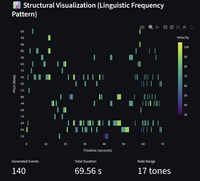
- Strukturelle Morphologie: Konvertiert Absätze und Syntax durch eine stringente Regelmatrix in Klang-Timelines – der Textblock fungiert als parametrischer Raumkörper.
- Typografisches Mapping: Übersetzt den inhärenten Rhythmus, den strukturellen Fluss und die Datendichte geschriebener Sprache in dynamische Akustiktopologien.
- Modulare Integration: Gibt rohe MIDI-Datenströme aus, die nahtlos in zeitgenössische digitale Arbeitsumgebungen eingespeist werden und sich durch komplexe Syntheseketten physisch materialisieren.
- Entwickelt als generatives Werkzeug für zeitgenössische Klangkunst und mehrkannalige Rauminstallationen, bietet das E-CODERA System eine Grundlage zur Erzeugung von Audiostrukturen, die vollständig durch die Materialität und Topologie des geschriebenen Wortes determiniert sind.
Das System interpretiert Sprache nicht semantisch. Stattdessen wird geschriebener Text als Material, temporale Struktur, Rhythmus und Partitur behandelt. Die resultierende Musik repräsentiert nicht die Bedeutung von Sprache, sondern vielmehr die physische und strukturelle Organisation des Schreibens selbst.
Regelwerk
- Verarbeitungsmatrix: Ein Text wird Zeichen für Zeichen gemäß einer strikten algorithmischen Matrix verarbeitet. Nur die musikalischen Koordinaten C, D, E, F, G, A, H, B lösen Audioereignisse aus. Alle anderen Zeichen erzeugen Negativraum, modulieren das zeitliche Raster oder initiieren formale Transformationen.
- Frequenzraster (P2): Das musikalische Alphabet wird auf folgende Frequenzwerte abgebildet: C=0, D=2, E=4, F=5, G=7, A=9, H/B=11. Die räumliche Basisachse (Referenzoktave) des Systems ist: Oktave 4.
- Satzbasierte Registerverschiebung: Satzzeichen fungieren als globale Modifikatoren für die Oktavzuordnung des gesamten Satzblocks: ! : +1 Oktave / !! : +2 Oktaven / !!! : Rücksetzung auf Basisoktave / ? : -1 Oktave / ?? : -2 Oktaven / ??? : Rücksetzung auf Basisoktave. Diese Verschiebung bleibt über den gesamten Satzdatensatz hinweg aktiv.
- Lautstärketransposition: Wörter mit hoher Datendichte (neun oder mehr Zeichen) werden strukturell eine Oktave nach oben transponiert.
- Temporales Raster (Dichte): Die Basisdauer jedes Notereignisses beträgt 250 Millisekunden. Für jedes nicht-musikalische Zeichen innerhalb eines Worts expandiert das temporale Raster aller musikalischen Ereignisse innerhalb dieses Worts um +50 Millisekunden.
- Negativraum (Stille): Alle nicht-musikalischen Zeichen erzeugen Leerstellen (Stille). Die Dauer jedes Leerraum-Ereignisses entspricht 1/4 der Basisdauer (Standard: 62,5 Millisekunden). Dies schließt nicht-musikalische Buchstaben, Leerzeichen, Satzzeichen und Sonderzeichen ein. Makro-Timing (Fluss-Modifikatoren):
- Komma (,): Das erste Vorkommen halbiert die Dauer (Geschwindigkeitsbeschleunigung); das zweite Vorkommen löst eine Rücksetzung auf die Basisdauer aus.
- Punkt (.): Setzt die Dauer auf den Standardwert zurück (struktureller Anker).
- Doppelpunkt (:): Verdoppelt die temporale Expansion aller nachfolgenden Ereignisse (Frequenzmultiplikation).
- Semikolon (;): Erzeugt einen zusätzlichen Leerraumblock (Stille) in Höhe der halben Basisdauer.
- Mikro-Artikulation: Fragmente (Wörter mit weniger als drei Zeichen) lösen ein Staccato-Gate aus. Ihre Dauer wird auf 40 % des errechneten Wertes verkürzt.
- Dynamische Gewichtung: Basis-Velocity: 70. Das erste Wort (Trigger) jedes Satzes erhält einen Velocity-Boost von +15.
- Ereignisakkumulation: Aufeinanderfolgende Wiederholungen identischer Tonhöhen bauen parametrischen Druck auf und erzeugen ein Crescendo (1: 70, 2: 90, 3: 110, 4+: 127).
- Großbuchstaben: Großgeschriebene musikalische Zeichen werden sofort wiederholt. Die wiederholte Note erhält +20 Velocity.
- Decrescendo – Strukturelle Degradation: Ein doppeltes Zeichen innerhalb eines Worts initiiert einen automatisierten Abklingprozess (90 → 70 → 50 → 30). Danach wird das Decrescendo automatisch beendet.
- Generative Schichtung (Harmonie): Zweites Vorkommen einer identischen Tonhöhe: Das System erzeugt eine reine Quinte. Drittes und nachfolgende Vorkommen: Das System bildet einen Dur-Dreiklang (polyphone Eskalation).
- Grenzmarker: Das letzte musikalische Zeichen jedes Worts wird durch eine Oktavverdopplung markiert.
- Sequenz-Fade: Das letzte musikalische Ereignis des letzten Worts eines Satzes erfährt ein Ritardando (Dauermultiplikator: 1,4).
- Unendliches Sustain: Auslassungspunkte (...) lösen den Haltezustand (Sustain) aus. Dieser Zustand bleibt aktiv, bis er durch einen expliziten Punkt (.) überschrieben wird.
- Konzeptuelle Synthese: Das Codera System versteht Typografie als parametrische Partitur für räumliche und zeitliche Organisation. Musik entsteht hier nicht als Vehikel für semantische Bedeutung, sondern als direkte akustische Manifestation der Zeichentopologie.
The E-CODERA System (ETSCS)
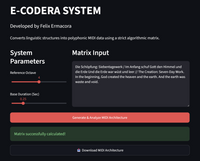
The E-CODERA System (Ermacora Text-To-Sound Composition System) operates at the intersection of linguistics and spatial audio. It bypasses semantic reading, analyzing text instead as a deterministic dataset for kinetic sonic architectures. Through the algorithmic evaluation of character strings, punctuation, and typographical density, the system generates complex, polyphonic MIDI matrices. The visual statics of the written word are translated directly into a haptic, multidimensional sonic framework—language becomes an algorithmic spatial sculpture
Structural Morphology: Converts paragraphs and syntax into hyper-detailed sonic timelines through a stringent rule matrix—the text block functions as a parametric spatial body.
Typographical Mapping: Translates the inherent rhythm, structural flow, and data density of written language into dynamic acoustic topologies. Modular Integration: Outputs raw
MIDI data streams that route seamlessly into contemporary digital workspaces (such as Ableton Live or AUM) and multi-channel setups, materializing physically through complex synthesis chains.
Developed as a generative tool for contemporary sound art and multi-channel spatial installations, the E-CODERA System offers a foundation for generating audio structures entirely determined by the materiality and topology of the written word.
Project Status: Ongoing Artistic Research & System Expansion
The E-CODERA System is currently within an iterative phase of research and development. Present focus areas include scaling parametric spatial topologies and testing the generated data matrices within complex, multi-channel installation environments.
The System does not interpret language semantically. Instead, written text is treated as material, temporal structure, rhythm, and score. The resulting music does not represent the meaning of language, but rather the physical and structural organization of writing itself.
- Processing Matrix: A text is processed character by character according to a strict algorithmic matrix. Only the musical coordinates C, D, E, F, G, A, H, B trigger audio events. All other characters generate negative space, modulate the temporal grid, or initiate formal transformations.
- P2. Frequency Grid: The musical alphabet maps to the following frequency values: C=0, D=2, E=4, F=5, G=7, A=9, H/B=11. The spatial base axis (reference octave) of the system is: Octave 4.
- 3. Sentence-Based Register Shift: Punctuation marks act as global modifiers for the octave alignment of the entire sentence block: ! : +1 octave / !! : +2 octaves / !!! : reset to base octave / ? : -1 octave / ?? : -2 octaves / ??? : reset to base octave. This displacement remains active throughout the entire sentence dataset.
- Volume Transposition: Words containing a high data density (nine or more characters) are structurally transposed one octave upward.
- 5. Temporal Grid (Density): The base duration of every note event is 250 milliseconds. For every non-musical character contained within a word, the temporal grid of all musical events within that word expands by +50 milliseconds.
- Negative Space (Silence): All non-musical characters generate voids (silence). The duration of each void event equals 1/4 of the base duration (default: 62.5 milliseconds). This includes non-musical letters, spaces, punctuation, and special characters.
- Macro-Timing (Flow Modifiers): - Comma (,): first occurrence halves the duration (rate acceleration); second occurrence triggers a reset to base duration. - Period (.): resets duration to the standard value (structural anchor). - Colon (:): doubles the temporal expansion of all subsequent events (rate multiplication). - Semicolon (;): generates an additional void block (silence) equal to half the base duration.
- Micro-Articulation: Fragments (words containing fewer than three characters) trigger a staccato gate. Their duration is truncated to 40% of the calculated value. .
- Dynamic Weighting: Base velocity: 70. The initial word (trigger) of every sentence receives a velocity boost of +15.
- Event Accumulation: Consecutive repetitions of identical pitches build parametric pressure, generating a crescendo (1: 70, 2: 90, 3: 110, 4+: 127).
- Uppercase Letters
Uppercase musical characters are immediately repeated. The repeated note receives +20 velocity. - Decrecsendo: Structural Degradation: A double letter inside a word initiates an automated decay process (90 → 70 → 50 → 30). Afterwards, the decrescendo is automatically terminated.
- Generative Layering (Harmony): Second occurrence of an identical pitch: the system generates a perfect fifth. Third and subsequent occurrences: the system forms a major triad (polyphonic escalation).
- Boundary Marker: The final musical character of every word is marked by an octave doubling.
- Sequence Fade: The final musical event of the final word of a sentence undergoes a ritardando (duration multiplier: 1.4).
- Infinite Sustain: An ellipsis (...) triggers the hold state (sustain). This state remains active until overwritten by an explicit period (.).
- Conceptual Synthesis: The Codera System understands typography as a parametric score for spatial and temporal organization. Music emerges here not as a vehicle for semantic meaning, but as a direct acoustic manifestation of character topology.